




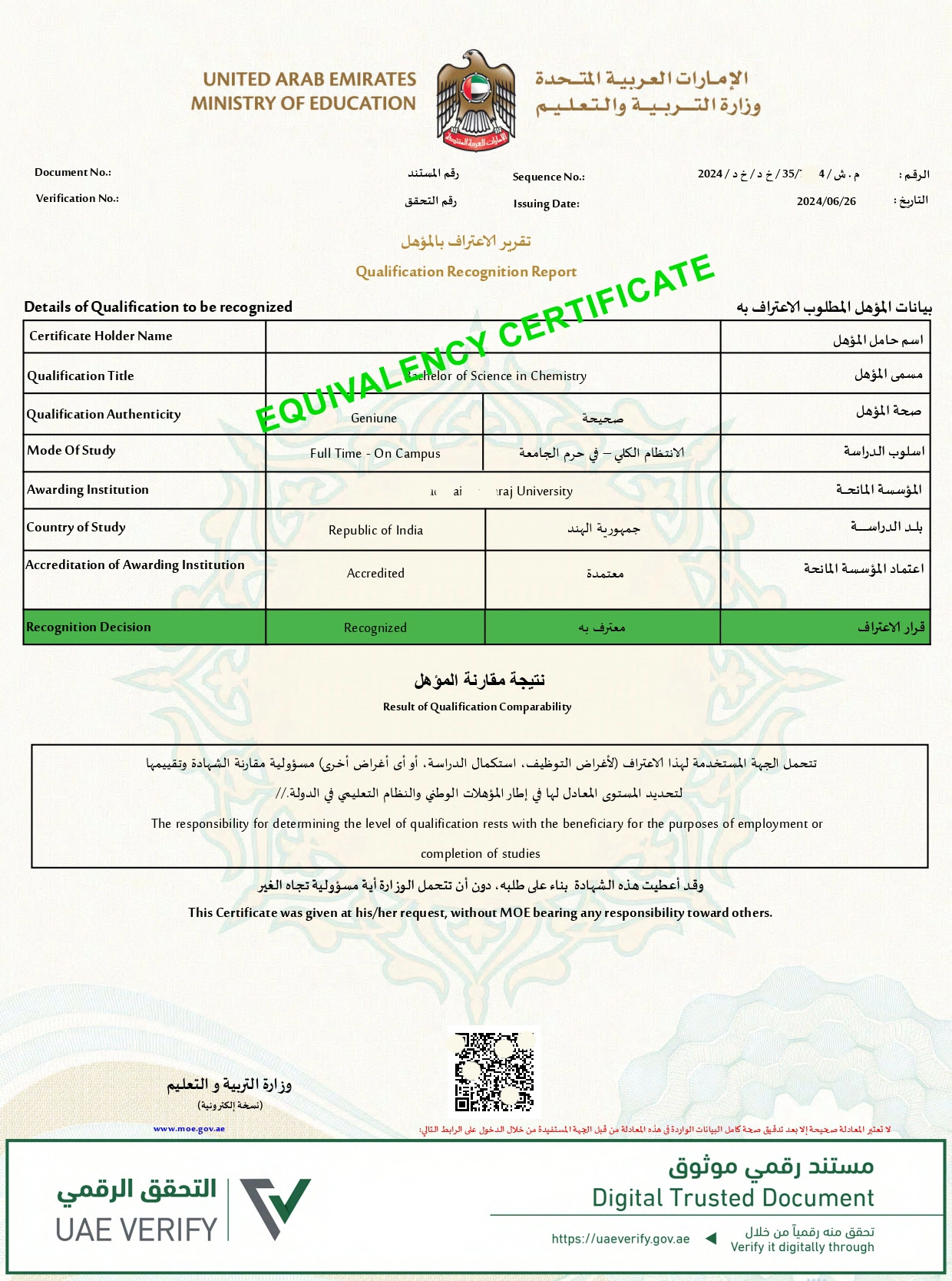
An equivalency certificate officially called a Certificate of Recognition is the document issued by the UAE government confirming that a foreign academic qualification meets national education standards. Whether you hold a bachelor’s degree from India, a nursing diploma from the Philippines, a medical degree from Pakistan, or a high school certificate from the UK, this document is your gateway to employment, professional licensing, higher education, and the UAE Golden Visa.
As of November 1, 2024, the responsibility for university-level certificate equivalency has shifted from the Ministry of Education (MOE) to the Ministry of Higher Education and Scientific Research (MOHESR), while Grade 12 (high school) equivalency remains under MOE. This guide covers the complete process for both, along with requirements, fees, timelines, and profession-specific guidance updated for 2026.
GloboPrime Corporate Services is a UAE-based corporate services provider offering end-to-end equivalency certificate assistance in Dubai, Abu Dhabi, Sharjah, and across the Emirates. We handle attestation, DataFlow verification, MOE/MOHESR submission, and follow-up on your behalf.
A certificate of equivalency now formally referred to as a Qualification Recognition Report or Certificate of Recognition is an official document that validates the comparability of a foreign educational qualification to the UAE’s academic standards. It is issued after a thorough evaluation process that verifies:
The foreign institution is accredited and recognised in its home country
The programme and curriculum meet UAE educational benchmarks
The qualification is authentic and not counterfeit
The study duration, credit hours, and learning outcomes align with the UAE’s National Qualifications Framework (NQF), also known as Qafā’ah
According to the official UAE Government platform (u.ae), the University Certificates Recognition system replaced the older University Qualification Equivalency system in June 2023. The updated framework simplifies recognition by basing the primary criteria on the international ranking of the degree-granting institution.
Key distinction: Equivalency and attestation are not the same. Attestation confirms a document’s authenticity through government stamps and signatures. Equivalency goes further it evaluates the academic content and level of the qualification against UAE standards. You need attestation first, then equivalency.
The equivalency certificate is not required by every expatriate — but it is mandatory in many professional, academic, and immigration scenarios. Based on UAE government regulations and licensing authority requirements, the following categories need it:
Any student who completed high school abroad and wishes to enrol in a UAE university must obtain a Grade 12 equivalency certificate from the Ministry of Education. This includes students with IB diplomas, IGCSE/A-Level qualifications, American high school diplomas, Indian CBSE/ICSE certificates, and other international curricula.
The UAE Golden Visa (10-year residency) requires academic equivalency for several categories. Professionals applying under the Managers/Chief Executives, Engineers, Doctors, Scientists, and Specialized Talents categories must submit an equivalency certificate. According to the official UAE government portal, highly skilled professionals need equivalency as part of their eligibility documentation.
Most government entities in Dubai, Abu Dhabi, and other emirates now require equivalency for foreign-qualified employees, particularly those in technical, scientific, and managerial roles.
Understanding which government body processes your application is essential to avoid delays:
| Qualification Level | Responsible Authority | Portal |
|---|---|---|
| Grade 12 / High School (within UAE) | Ministry of Education (MOE) | moe.gov.ae |
| Grade 12 / High School (from abroad) | Ministry of Education (MOE) | moe.gov.ae |
| Bachelor’s Degree | Ministry of Higher Education & Scientific Research (MOHESR) | mohesr.gov.ae |
| Master’s Degree | MOHESR | mohesr.gov.ae |
| PhD / Doctorate | MOHESR | mohesr.gov.ae |
| Diploma (post-secondary) | MOHESR | mohesr.gov.ae |
As of November 2024, MOHESR officially took over all university-level recognition services, consolidating the process under one authority. High school equivalency remains with MOE.
In June 2023, the UAE Ministry of Education announced the University Certificates Recognition system, which replaced the previous University Qualification Equivalency system. According to the official MOE announcement, the new system introduced significant changes:
| University Ranking | Requirements for Recognition |
|---|---|
| Ranked 1–200 globally | Certificate verification only — no additional criteria |
| Ranked 201–600 | Certificate verification plus standard conditions |
| Ranked 601 and above | Certificate verification, accreditation proof, and additional criteria may apply |
| Specialised professions (engineering, medicine, law) | Additional profession-specific requirements regardless of ranking |
This means that if you graduated from a top-200 university, the process is significantly faster. For universities ranked lower, additional documentation may be required.
The equivalency process consists of two mandatory stages. You must complete Stage 1 before starting Stage 2.
Step 1: Attestation in Your Home Country
Before any equivalency application, your degree certificate and transcripts must be attested through the standard attestation chain:
GloboPrime handles the complete attestation chain for documents from India, Pakistan, Philippines, UK, USA, Egypt, Bangladesh, Sri Lanka, Jordan, Nigeria, South Africa, China, Iran, Nepal, and all other countries.
Step 2: Primary Source Verification (DataFlow or QuadraBay)
The MOE/MOHESR requires all foreign degrees to undergo Primary Source Verification (PSV). This is conducted by one of two authorised partners:
According to the MOE Applicant Welcome Kit, the DataFlow PSV fee is AED 300 + 5% VAT for one degree (regular service), with additional degrees at AED 280 + 5% VAT each.
The verification process typically takes up to 30 business days after document submission, though timelines vary based on the responsiveness of your university.
Important: A previous DataFlow verification conducted for another authority (such as DHA or MOHAP) cannot be used for MOE equivalency — each authority has different requirements.
Step 3: Genuinity Letter (if applicable)
A genuinity letter (also called a genuineness letter) is a document obtained from the UAE embassy of the country where you studied. It confirms that your university or school is genuine and recognised. This letter is mandatory for degrees from certain countries. For countries that MOFAIC communicates with directly, this step may not be required.
Step 4: Register with UAE PASS
UAE PASS is the national digital identity platform required to access the MOE/MOHESR equivalency portal. Download the UAE PASS app from the App Store or Google Play and register using your Emirates ID, GCC ID, or passport. Complete the identity verification process — you must have an active UAE PASS account to submit your equivalency application.
Step 5: Submit Your Application on the MOHESR/MOE Portal
Log in to the appropriate portal using UAE PASS:
Upload all required documents, ensuring that your application details match your supporting documents exactly. Pay the applicable fee.
Step 6: Processing and Issuance
The MOHESR/MOE reviews your application. Processing typically takes 5 working days for straightforward cases, though it can extend to 2–6 weeks for complex cases or when additional documents are requested.
Once approved, the official Certificate of Recognition is issued digitally to your registered email address.
The specific documents vary depending on your qualification level and country of study. Here is the comprehensive list:
For University Degrees (Bachelor’s, Master’s, PhD)
Additional documents for specific qualifications:
For Grade 12 / High School (General Education)
The total processing time depends on your country of study, university responsiveness, and whether additional verification is required. Below is a realistic end-to-end timeline based on current MOHESR processing patterns.
| Stage | Estimated Duration |
|---|---|
| Home country attestation (education authority → MOFA → UAE Embassy) | 2–6 weeks |
| UAE MOFA attestation | 1–3 working days |
| DataFlow or QuadraBay verification (Primary Source Verification) | 15–30 working days |
| MOHESR review after submission | 5 days – 4 weeks |
| Total end-to-end timeframe | 6 weeks – 4 months |
You can track your application directly through the government portal used for submission:
Applicants typically receive:
Engineers in the UAE must register with the Society of Engineers (SOE) to practice legally, especially in Dubai. The SOE card application requires:
Engineers applying for the UAE Golden Visa under the Engineers category need both the equivalency certificate and a minimum monthly salary of AED 30,000. Architects follow a similar equivalency process to engineers.
All healthcare professionals must have their degrees equivalised before applying for a medical license. The licensing bodies — DHA (Dubai), MOHAP (Federal), and DOH (Abu Dhabi) — each require equivalency as a prerequisite. The process includes:
Dentists, pharmacists, physiotherapists, and other allied health professionals follow the same framework with profession-specific examination requirements.
All foreign-qualified teachers must equivalise their highest qualification (typically a bachelor’s degree in education or a subject-specific degree with a teaching qualification). The licensing body depends on the emirate:
Note: A two-year Bachelor of Education diploma alone may not be sufficient for equivalency — the full bachelor’s degree is typically required.
Lawyers wishing to practice in the UAE need their law degrees recognised through equivalency, which is then used for Ministry of Justice or local bar registration. Accountants, HR professionals, and other corporate professionals may need equivalency for government-sector employment, senior positions, or specific visa categories.
The attestation process before equivalency varies significantly depending on your country of study. Here is a summary for the most common nationalities in the UAE:
Attestation chain: University verification → State HRD attestation → MEA (Ministry of External Affairs) apostille/attestation → UAE Embassy attestation → UAE MOFA attestation → DataFlow verification → MOE/MOHESR application.
Common Indian degrees processed: B.Tech, MBBS, MBA, B.Com, BBA, M.Tech, MD, B.Ed, B.Sc Nursing, B.Pharm, LLB. Indian degrees from UGC-recognised universities are generally accepted. AICTE-approved technical institutions are also recognised.
Attestation chain: HEC attestation (Higher Education Commission) → Pakistan MOFA attestation → UAE Embassy attestation → UAE MOFA attestation → DataFlow → MOE/MOHESR.
Pakistan HEC verification is a critical first step. Degrees from PEC (Pakistan Engineering Council) registered programmes are required for engineering equivalency.
Attestation chain: DFA (Department of Foreign Affairs) authentication → CHED (Commission on Higher Education) verification for professional degrees → UAE Embassy attestation → UAE MOFA attestation → DataFlow → MOE/MOHESR.
Filipino nurses, teachers, and engineers are among the largest groups applying for UAE equivalency. BSN (Bachelor of Science in Nursing) degrees are commonly processed for DHA/MOHAP licensing.
Attestation chain: Degree verification via Ecctis (formerly UK NARIC) or university confirmation → Apostille from UK Foreign, Commonwealth & Development Office → UAE MOFA attestation → DataFlow → MOE/MOHESR.
UK degrees from Russell Group universities typically fall within the 1–200 ranking category, qualifying for the simplified recognition pathway.
Attestation chain: University verification → Apostille from the US Secretary of State’s office (state level) → UAE Embassy attestation → UAE MOFA attestation → DataFlow → MOE/MOHESR.
US degrees from regionally accredited institutions are generally recognised.
Arab country degrees typically follow: Home country MOE attestation → Home country MOFA attestation → UAE Embassy attestation → UAE MOFA → DataFlow → MOE/MOHESR. Arabic-language documents may still need certified English translation for the equivalency process.
Similar attestation chains apply, with country-specific education ministry verification. Additional accreditation documentation may be required for universities from these regions.
South Asian countries (outside India and Pakistan) follow similar patterns with local education ministry attestation followed by the UAE attestation chain.
Chinese degrees require verification from the Chinese Service Center for Scholarly Exchange (CSCSE). Iranian degrees follow the standard attestation chain with the Iranian MOFA and UAE Embassy.
The 2023 University Certificates Recognition reform significantly changed how the UAE evaluates online degrees. Under the updated recognition framework, online and distance-learning qualifications are now eligible for equivalency in most academic fields.
In general:
In some cases, the authority may request a university letter confirming:
Specialised professions still require traditional in-person study due to licensing regulations.
School-level equivalency is handled separately from university degrees and remains under the UAE Ministry of Education (MOE).
This applies to students with foreign secondary certificates who plan to:
Recognised curricula include IB, British A-Levels, American diplomas, CBSE/ISC, and other international systems.
Because school equivalency follows a different authority and process, we cover it in detail here: → High School Equivalency Certificate UAE
Equivalency has become one of the most common reasons professionals apply for degree recognition. Many Golden Visa categories require formally recognised academic qualifications.
Common categories requiring equivalency include:
Without a recognised degree, Golden Visa applications based on academic qualifications may be delayed or rejected.
For this reason, most applicants begin the equivalency process before submitting their Golden Visa application.
GloboPrime Corporate Services provides degree certificate, diploma & high school certificate attestation and equivalency certificate services from our offices in Abu Dhabi and Dubai:
What we handle:
Whether you need an equivalency certificate in Dubai, Abu Dhabi, Sharjah, Ajman, or Ras Al Khaimah we serve clients across all emirates and can manage the process remotely for those outside the UAE.
Educational Documents